
Breaking Down the Continuum of Reading Skills into Literacy Levels

A young woman with long dark hair is lying down and reading a book, holding it open with both hands. The book’s cover is plain and light-colored. She appears focused and relaxed.
Smiling person with glasses and brown hair in a bun, wearing a black top and a colorful pink and white scarf, outdoors with a blurred natural background.

by Donna Clarke
Literacy Centre of Expertise Lead
Cover of the “Canadian Language Benchmarks: ESL for Adult Literacy Learners (ALL)” guide, with large faded numbers and maple leaf graphics in the background, and the phrase “Language is the Key” at the bottom.

Many first-language learners don’t realize the depth of their reading skills. I certainly didn’t until I started teaching literacy learners. In ESL for ALL, these skills are broken down into specific parts. It is a great resource that all literacy teachers should know and use regularly.   

The Continuum of Reading Skills Development offers a three-point continuum with five increments along the way (pages 108 – 123, ESL for ALL):

Text graphic with three words in sequence: "EMERGING" followed by a right arrow, then "BUILDING" with another right arrow, and finally "EXPANDING." The arrows indicate progression from one stage to the next.

The continuum, however, is not necessarily aligned to Literacy levels and there is a copious amount of information in the document. For these reasons, I broke it down into the level I teach: Literacy Foundation/Literacy 1.  
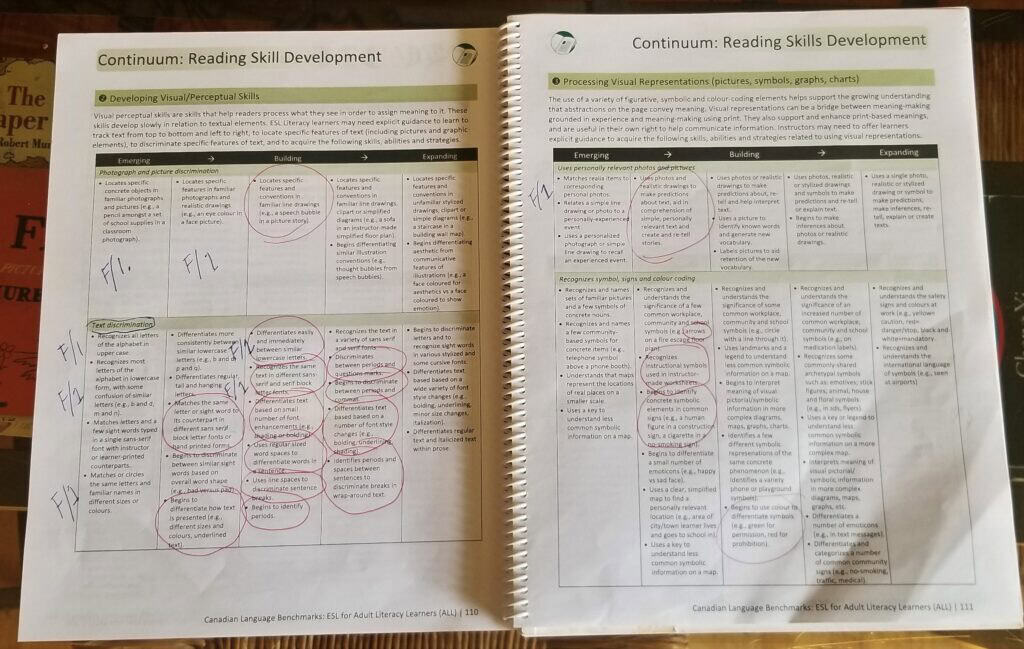
A spiral-bound book is open to two pages with reading skill development charts. The left page is heavily marked with red circles and “F1/F2” notes, while the right page has fewer red markings. Text and grid lines are visible throughout.
My often used and heavily marked up
ESL for ALL book.

After a few semesters I abandoned the scribbles in my book for a more organized and directed approach. For reference, I used the Literacy Reference List compiled by ECSD (Edmonton Catholic School District) and the ISANS Literacy Curriculum Guidelines available on Tutela.

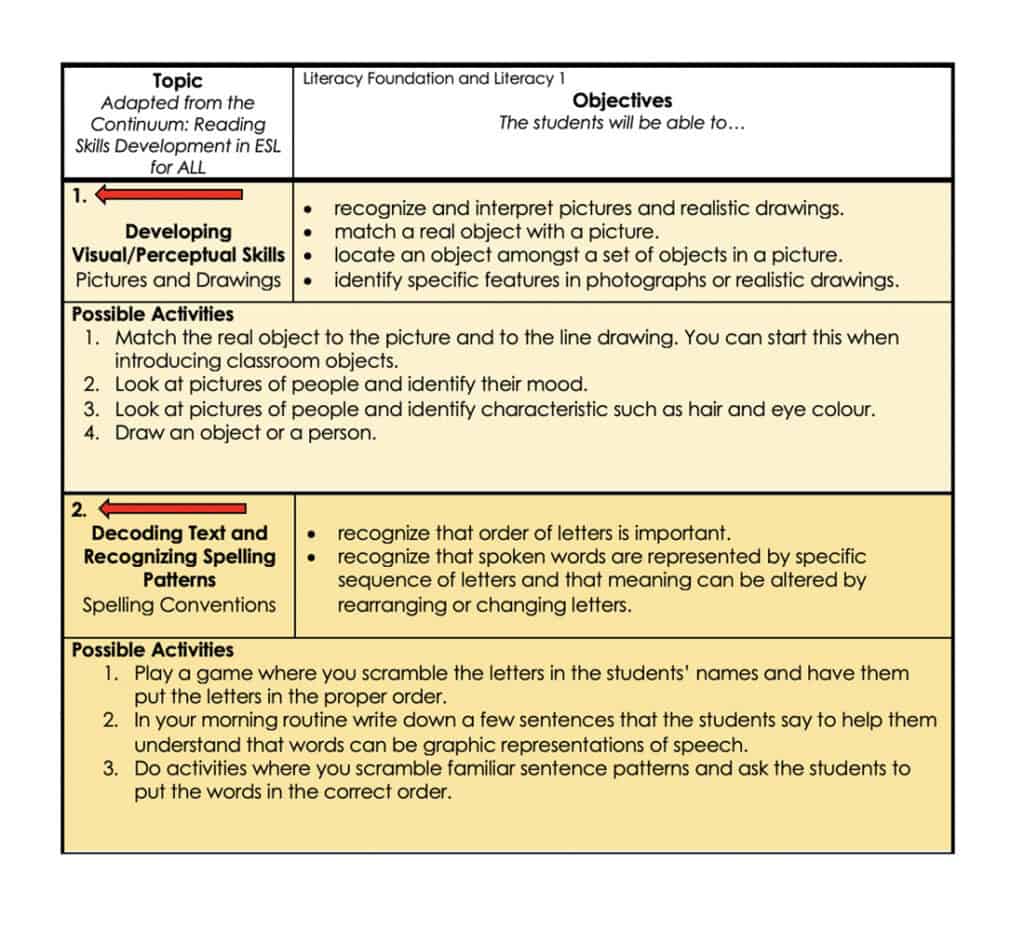
The result is a document that has ten topics with objects and activities and a separate checklist for teachers.

Feel free to download the Word version of these documents to use as you wish. Some modifications will be necessary for those teaching online. Feedback and collaboration are more than welcomed.  
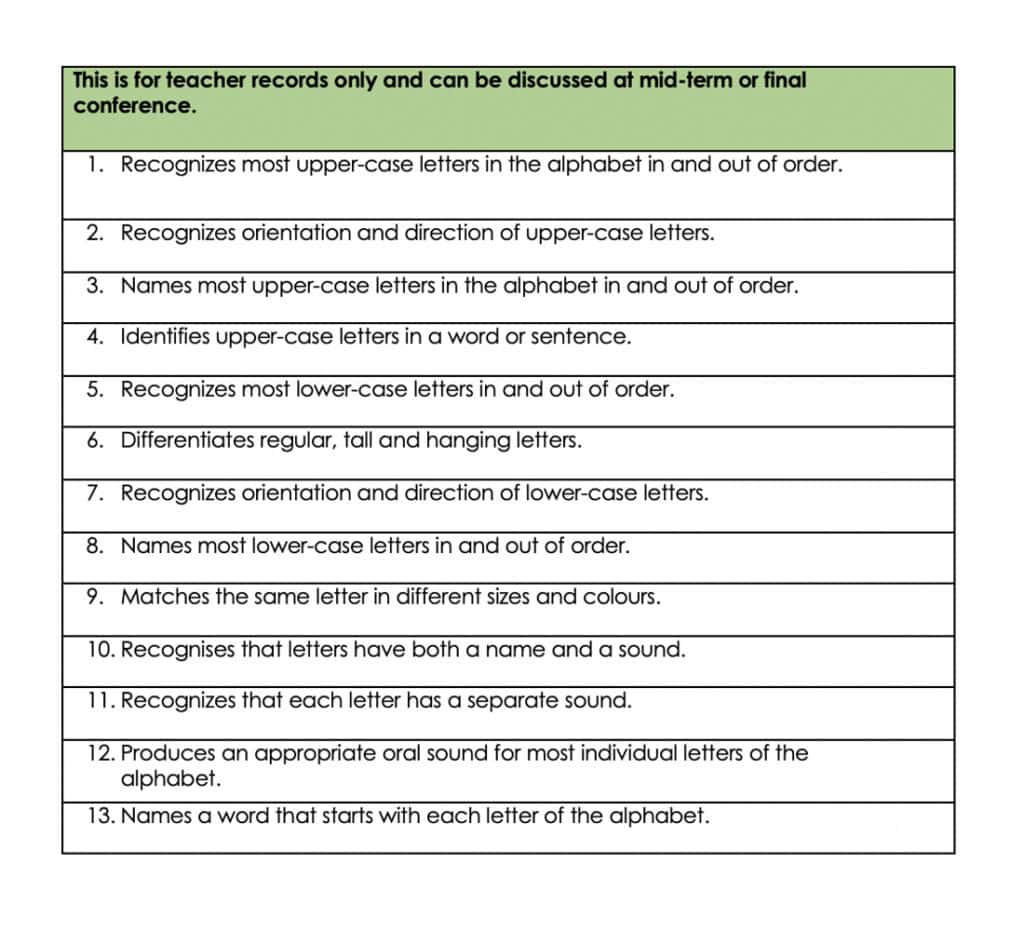
A checklist of reading skills for teacher records, including recognizing and naming upper- and lower-case letters, matching letter cases, differentiating letter types, and identifying letter sounds and words.

Click Here for Reading Skills Checklist

Share this article:
Translate